
Epicor is Moving to the Cloud. Should You Upgrade, Replace, or Stay?
Epicor is ending support for certain on-premises releases of Kinetic, Prophet 21, and BisTrack. This is part of a broader ERP shift to the cloud, driven by faster innovation, scalability, and advanced capabilities like AI and analytics.
For organizations running these systems, end-of-life does not remove choice.
It narrows the decision window.

Can cloud deployment meet your regulatory and compliance requirements?

Can your customizations and integrations migrate cleanly to the cloud?

Do you have the governance maturity for cloud release and change cadence?

Are your performance and scale requirements a fit for cloud?
Which Strategy Fits Your Organization: Upgrade, Replace, or Stay?
Upgrade to
Epicor Cloud
Best fit for:
Organizations that can support cloud operations while balancing customization and performance needs
Benefits:
- Continuous updates for features and security
- Scalable infrastructure without new hardware
- Access to modern capabilities (AI, automation, analytics)
Risks:
- Frequent updates may require stronger change governance and a faster operating cadence
- Heavily customized environments may require rework to align with cloud standards
- Some performance profiles may require higher-tier cloud options, changing cost and architecture assumptions
Replace
Your ERP
Best fit for:
Organizations where Epicor no longer fits future-state needs
Benefits:
- Realign ERP to your long-term business objectives
- Address structural fit gaps that cannot be solved within the current ecosystem
- Build a foundation for future capabilities
Risks:
- Higher effort and investment across selection, implementation, integrations, and data migration
- Greater change impact, including process redesign, user training, and structured change management
- Longer timelines and higher upfront costs
Stay on
Sustaining Support
Best fit for:
Organizations with stable operations facing capacity, complexity, or regulatory constraints
Benefits:
- Maintain business continuity without forcing a rushed ERP decision
- Preserve bandwidth for higher-priority initiatives (e.g. R&D, operations)
- Create runway to plan and sequence modernization deliberately
Risks:
- Limited support with no new features or innovation
- Ongoing reliance on legacy infrastructure and specialized skills
- Risk and cost typically increase over time as the system ages
Now is the time to reassess your ERP strategy
Define your constraints and objectives before you commit to a path.
Not sure what to prioritize first? Pemeco helps organizations translate real constraints into an executable ERP plan. From customizations and integrations to cloud performance, we’ve guided hundreds of organizations through the real-world nuances that shape ERP selection and implementation since 1978.
Epicor’s end-of-life is an opportunity to reassess your ERP strategy. Make a structured assessment of your systems, constraints, and priorities to determine you next path forward
Epicor On-Premises End of Support: What It Means and What to Do Next
Resources
Explore our expert resources to help prepare your business for the cloud.

Replacing or upgrading your legacy ERP
is a strategic decision. Learn about the pros and cons of a cloud ERP to
determine if it’s the right fit for
your organization.
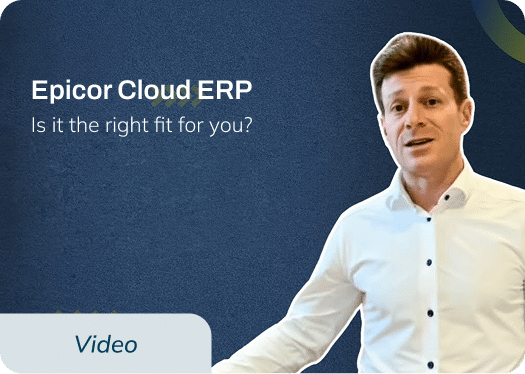
Migrating from a legacy Epicor ERP to the cloud isn’t one-size-fits-all. Hear Jonathan Gross explain how to assess SaaS fit, TCO, and readiness before you commit.

Moving to the cloud takes more than a technical upgrade. Watch this video to learn the readiness considerations leaders must address for a successful cloud move.
Case Studies

Uni-Fab, a mid-sized manufacturer, struggled to scale as fragmented systems reduced visibility and slowed decisions. Pemeco uncovered operating model and governance gaps, then guided a phased migration to Epicor Kinetic Cloud to enable consistent execution and long-term growth.

From Eight Disjointed ERPs to One Scalable System
A global, multi-entity industrial manufacturer was running eight separate legacy ERPs that limited growth. Pemeco led an end-to-end consolidation to Epicor Kinetic, building the business case and standardizing processes and master data. The result was a repeatable ERP blueprint that reduced risk and enabled scale through consistent execution and real-time insight.

De-Risking ERP Execution to Support Acquisition-Led Growth
One of North America’s largest industrial distributors was committed to Epicor Prophet 21 but faced rising commercial and execution risk as it scaled through acquisitions. Pemeco strengthened the commercial model and established a repeatable global design to prevent fragmented rollouts and enable scalable expansion.

The entire company was astounded that such a complicated project could be so successful and delivered on time. The Pemeco implementation methodology, ‘Milestone Deliverables’, provided a comprehensible roadmap to follow with clearly-marked, tangible deliverables serving as signposts along the way. We moved to our new ERP systems on the final weekend and balanced our $51M of inventory to the penny!
Russ Finney
Former CIO of Tokyo Electron Americas
Why Trust Pemeco
100% ERP Success Rate
We have an unmatched track record in the industry, with over 800 major projects successfully delivered.
Vendor Neutrality
Pemeco is an independent consulting firm, ensuring an objective selection process without vendor influence.
Proven Methodologies
We ensure client success by cultivating a culture of ownership and following a rigorous, outcome-driven approach. Our frameworks and methodologies are industry gold standards, used in 40+ countries.
Deep Cross-Industry Expertise
Our consultants bring decades of first-hand industry knowledge and experience, guiding your business to its optimal future state.
Trusted by Global Enterprises




Frequently Asked Questions
Epicor Kinetic is the latest, cloud-enabled version of Epicor ERP, evolving from prior generations E10, E9, and Vantage. It offers modern cloud deployment, real-time analytics, and industry-specific functionality designed for manufacturing and distribution.
📌 Learn about the benefits of moving to cloud.
Epicor Kinetic modernizes ERP by adding cloud-native capabilities while retaining Epicor’s manufacturing heritage. Key differences include:
- Cloud-native design: automatic updates, scalability, vendor-managed infrastructure
- User experience: modern browser-based UX and mobility compared to older Windows forms
- Extensibility: REST APIs and low-code tools for integrations vs. heavy customizations in legacy systems
- Analytics: real-time dashboards and embedded analytics vs. bolt-on reporting
Cloud lowers infrastructure costs and accelerates updates, while on-premise offers control and customization.
- Cloud – subscription model, scalability, vendor-managed updates and security
- On-Premise – capital investment, internal control, more customization flexibility
- Hybrid – mixes local control with cloud scalability
Pemeco builds TCO and risk models to guide deployment choice.
📌 Learn how Pemeco can help you make the right decision.
Upgrading may preserve investments, but fresh implementations often deliver cleaner processes and lower long-term risk. Factors to weigh:
- Compatibility of customizations and extensions
- Data migration complexity (clean vs. legacy data carryover)
- Organizational readiness for change and process redesign
- Epicor roadmap alignment and long-term support lifecycle
Pemeco compares upgrade vs. fresh implementation scenarios, quantifying cost, risk, and ROI.
Most Epicor implementations take 6–12 months. Timelines depend on:
- Number of modules and users
- Customization and integration needs
- Data migration readiness
- OCM and training requirements
- Strength of governance and project teams
📌 Explore what companies underestimate about ERP implementation here.
Most failures stem from governance, requirements, and change management gaps.
- Misaligned expectations and scope creep
- Weak governance and decision rights
- Poor data migration planning and testing discipline
- Underestimating OCM and training
- Over-customization leading to technical debt
Pemeco prevents failure with its Milestone Deliverables methodology, embedding governance, risk management, and OCM.
Epicor competes with several strong mid-market and enterprise ERP platforms. Top alternatives include:
- Oracle NetSuite
- Microsoft Dynamics 365 Business Central
- Microsoft Dynamics 365 Finance & Supply Chain (F&SC)
- SAP S/4HANA
- Infor CloudSuite Industrial (SyteLine)
- Acumatica
- IFS
Pemeco conducts vendor-neutral evaluations to compare Epicor against these and other platforms based on requirements, TCO, and ROI.
Pemeco provides independent leadership to ensure Epicor projects deliver measurable business value. Our differentiators include:
- Milestone Deliverables methodology anchoring scope, budget, and timeline
- Organizational change management programs to secure adoption and ROI
- Proven track record from 800+ ERP projects, including Epicor implementations across North America
We also oversee integrations, data migration, and testing to minimize risk.
📌 See how Pemeco deliver outcomes.